Monday, 28 December 2015

How Training and Weight Loss improves Running Speeds

My running time improvements in 2015
In 2015, I returned to running after a break of some years.
After a slow start (on that first run my legs hurt after just 1.8 km!), I slowly built speed and distance, eventually topping out with a half-marathon in 2 hrs 27 minutes. Not exactly world class (I work with a guy a bit older than me that can run a full marathon in pretty much 3 hrs, give or take a minute or two either way). But for my first run of that distance in about 30 years, I was pretty pleased with myself.


I also find that having a bit more "breath" in me helps with my cycling, too
Technically, it is cardio-pulmonary improvement that I am noticing, but in practice it means I don't get so out of breath on hills!

Anyway.
How I did it: part A
1) build up distance and speed slowly over a long period. Don't just get up and try to run a record speed or distance, keeping going until you injure yourself
2) take rest weeks every now and then to give your body a chance to regrow all that lovely new muscle etc. etc.

How I did it: part B
1) I started off "free-style" running for about 6 weeks (weeks 3 to 8 on the chart above).

2) Then I started using a "perceived effort" pacing system (week 9), which shows up pretty clearly in the charts. Pacing to an approximate physical sensation (like degree of breathlessness) helps with pacing longer events. Just look at that 10k improvement!

3) Then I started using a BlueTooth heart rate belt and my wife's smartphone. But I found it rather cumbersome. But I was aiming to run in "zones" based on my Maximum Heart Rate.

4) So I splashed out on a "proper" sports watch - a Garmin 310xt, which is a (now) recently discontinued device, that was originally introduced as Garmin's top-of-the-range "tri-athlon" watch in 2009. The 310xt is still onsale from some outlets at a heavily discounted price, and I got mine, along with a "deluxe" heart rate belt for just 125 pounds ($188). You can read my review of the 310xt here.
the 310xt has "alerts", so it can be set up to beep and vibrate, and if you set up a heart-rate band for the alerts (say 155 to 165 bpm), then the watch cen help you stay in this band, while at the same time not requiring you to stare at it all the time. I have mine set up to beep once every kilometre, so I can keep a general eye on the numbers while still looking where I am going!
I got the watch at about week 22.

5) Then I started using lactate threshold heart rate for pacing from about week 26.
I knew that running 10k at that point in time would take me about an hour, so if I ran for about at hour at my "1 hour rate" (a.k.a. "lactate threshold"), then that would give my best 10k time.
So I did. Here's how I got on. as you can see, my heart rate is pretty constant, given that the course is undulating, except for a surge at the end, when I was really going for it!
The fact that I had enough energy to surge at the end suggests that I could have run the whole distance just a couple of heart beats a minute faster throughout.
But then it was onto cycling for the rest of the Summer.

How I did it: part C
1) I lost weight. You can see my weight loss during the year here. in fact, I,ve lost a bit more since then, and I am now about 82.5 kg (181 lbs), a weight I haven't been for about 17 years! I've recently set a few new personal records, despite not being in the best shape (quite a break from running over the Summer while I was concentrating on cycling!), and the big reason for that is that I am now a good 10kg (22 lbs) lighter than I was in the Spring/Summer

2) Light people run quicker. Owen Barder has an excellent tool to indicate just how much faster or slower you will go (with no other changes to yourself/training), if you lose or gain various amounts of weight.
Actually I suggest you explore Owen Barder's whole website, as I certainly found it helped me with information and encouragement. So I run a mile in about twice Roger Bannister's memorable 4 minute record. But he wasn't 51 at the time! How do I measure up against folks MY age?
There is a good online book of his on the site, too


Thursday, 24 December 2015

A bit of friendly competition

Things just got serious.

In 2015, I was the best rider from my workplace on the local 100km charity sportive - the Tour de Vale.
Actually, I was the ONLY rider from my workplace :-)

Naturally, I've been "bigging it up", and doing the "you should give it a go next year" line.

Anyway, looks like my colleague, John, has risen to the challenge.
Everyone knows that a "sportive" isn't a proper race, so it doesn't matter which of us covers the ground fastest, as there are no winners and losers, just finishers and non-finishers.

Yeah, right.

Back in the real world, it matters.

And, to make it worse, John is a darned fine rider. He has far more "competition" experience than me, as he used to be a serious MTB rider.
Way back when.
John has a bigger equipment budget than me, and a "better" bike that is about 8 kilos lighter than mine, too.
Actually, John has several bikes which are both "better" and lighter than mine.
All I have is Mermaid, my 18kg "cheapie".

So I am going to get my butt kicked, so as to speak.

Or perhaps not.
I have three main weapons.
1) I am about 20 kilos (44lbs) lighter than John - good job I've lost almost 14 kilos (30 lbs) this year. I'm going to try to shift a bit more before the event itself, as well.
2) I am using fancy software for training analysis (Training Peaks)
3) I clocked up about 6 metric "centuries" in 2015, and I will be starting 2016 at both my lightest and fittest for about 20 years.

I have one other "secret" weapon. A resting pulse in the 40's.
You just can't buy that.
OK, so it is mostly genetic, with just a touch of fitness on top.
You can't buy genetics.

But all of that will not be enough by itself.
I'm going to have to train more effectively than John, too.
And since John is no fool, that is going to require some serious hourage.
Boring paced work, not just pleasure riding with a few hills thrown in.
A serious exercise program, too, off the bike as well as on.
Some serious running early in 2016 to improve my cardio-pulmonary system.
Strength exercises.
Structured training designed so I reach my peak for the event - not before, and not after.

Let's see how it goes.
Nothing like a bit of friendly competition to get one motivated!

Sunday, 6 December 2015

Losing my KOM

A couple of days ago I lost two of my KOMs.
Boo hoo.
I don't actually know how many KOMs I had before that, but I know it isn't very many.
It is incredibly tempting to try to get those KOMs back.

However.

The difference between training and playing is whether your activities support your longer-term goals or whether it is about pride.
An effective athlete must be humble to achieve their goals.

Think about your goals.
If your goal is to get as many KOMs as possible, then search Strava or the overlooked ones on some minor road. Check the weather for when certain segments will have a HUGE tailwind (we are experiencing 45 mph, 72 kph, gusts from the South-West at the moment). Pump up your tyres extra hard, and off you go! Have fun.

But is that my goal?
No, it isn't.
So how did I get the KOM in the first place?
Well, as part of my training for my audax/randonnee ride in the Summer of 2015, I did quite a bit of running. Cardio-pulmonary fitness is the same whether you build it up running, cycling, or doing any other intense physical activity.
And the KOM?
Well, I run around a loop of streets near me that is about 1 mile (1.6 km) long.
I simply made one loop into a segment. There is a downhill bit and an uphill bit and a couple of flat bits. A nice little loop. Strava tells me I have run that segment over 100 times since I set it up.
On my (now lost) KOM lap of that segment, I did an 11.2 km run.
A little 1.2 km warm-up, then a 10km serious effort. This was the run I have mentioned before that afterwards I just sat on the edge of the road and rested. A neighbour stopped his car to check if I had had a heart attack or something, I looked that shattered.
But it was a 10km loop that went through that segment 6 times.
You don't have to be a genius to work out that if I JUST ran the segemnt again, just ONCE, as a classic "mile" run, rather than as a small part of a 10km run, I would go faster.
Plus I have lost about 6kg (13lbs) in weight since then, so that alone would knock 40 seconds or so off my time for that mile - my legs have less belly to move about now!

http://www.runningforfitness.org/calc/racepaces/rp?metres=10000&hr=0&min=58&sec=22&age=50&gender=M&Submit=Calculate suggests I could knock about a minute of my PR for that ex-KOM segment just by running it as a stand-alone run rather than as a small part of a longer run. That alone would give me the KOM back :-)
http://www.runningforfitness.org/calc/diet/weighteffect?metres=1609&hr=0&min=8&sec=09&weight=87&weightunits=kg&Submit=Calculate suggests I could knock off another 30 seconds or so due to the weight loss. So that KOM looks like an easy one to retake.

But let's stand back a little and thing about the bigger picture.
What am I attempting to achieve?
Many of you already know the answer - I am hoping to get a good time (sub 5 hrs, which will be 22 minutes quicker than my 2015 time) in the local 62mile (100km) sportive - the 2016 Tour de Vale - AND do a 200 to 250 mile (320 to 400km) audax/randonnee ride in the Summer of 2016 too.

Like most folks, I have a full-time job, so my training time is not exactly unlimited.
My training should therefore be focussed on stuff which will help my twin goals (Tour de Vale and audax/randonnee) for 2016.
I was hoping to go out for a spin on the bike this morning - get maybe 30-ish miles in (50 km).
But no.
They are behind at work, and the three hours I would have spent riding will be spent at work instead. On a Sunday. Looks like it is panning out into a long run up to Christmas. I'm working 6 days next week, so that'll make 13 days running at work, and it may actually get worse than that.
It's not all bad, though. Work gives me the financial resources to pay for the bike in the first place! I was just eyeing up some new tyres online last night, too :-) Hoping to be getting a power meter for 2017, and that's not going to buy itself either!

So that KOM doesn't look like it will be a big part of my plans.
I ran a couple of slow-ish 10Ks in November, just to keep in shape, but really if I want to be concentrating on longer cycle events, I need to be concentrating on longer distance running.
Longer-distance running is much more similar to longer-distance cycling, especially when you get past about 15km and start to actually eat and drink as part of the event. I ran a half-marathon as part of my preparations last year (including running through that ex-KOM segment 12 times!), and I ate and drank a bit about every 40 minutes - just like I do when cycling long distances.

And that, really, is the difference between playing and training.
Play is fun. Training often isn't. It is easy to get distracted while training, and find oneself playing instead.

But you have to "keep your eyes on the prize", as they say.
Which is why most folks never achieve their potential - they play instead of train.

So I'd best forget about that KOM, then :-)

Sunday, 29 November 2015

What's YOUR creatine level.

So, what's the level of creatine in your blood?
Don't know?

Let me put it like this.
British Cycling, the organization that is in charge of cycling in the UK (and, incidentally, issued the racing licences held by Mr Wiggins' and Mr Froome) say they have been using it on their cyclists for a decade (their words).
Apparently, creatine increases endurance, and that extra endurance allows harder training, which is why it is associated with extra muscles. It is not the creatine as such that gives you the muscles, it is the extra training it allows.

I took creatine supplements of about 9mg a day for 3 weeks in the Summer (along with some BCAA supplements and some multi-vitamins). Whether it helped me, I don't know, because I have no control to compare it to. The three weeks, I am assured by my body-building friends (body-builders tend to be creatine fanatics!) wouldn't have added much muscle, but I "probably" got the endurance benefits. Summer over, and I stopped taking it again. Within a month or so it would have all been pee'd out of my body.

So, do I know MY creatine levels?
Well, actually, I kind of do.
It has been measured during several of the other sets of tests I have had over the years.
Here are my numbers (no supplements involved - these are my "natural" numbers)
1st April 2008 (age 43) = 68 umol/L
16th June 2009 = 63 umol/L
23rd June 2009 = 68 umol/L
30th June 2009 = 69 umol/L
7th July 2009 = 69 umol/L
28th July 2009 = 64 umol/L
9th December 2009 = 57 umol/L
18th February 2013 = 61 umol/L
13th October 2015 = 62 umol/L

Apparently, "normal" is between 63 and 111 umol/L.
It is safe to conclude, therefore, that I have pretty low levels of creatine, and I sometimes fall below the "low" end of the "normal" range.
Extra creatine, therefore, could well be expected to have a significant effect on me, which is why I took it.

Do you take sports supplementation?
Do you know your "natural" levels, or are you just taking them because everyone else does?
For serious sport, there is always the medical exemption. A guy like me, with the various long-term health issues I have piled up over the years, could get an exemption from loads of stuff that would get other people banned :-)
(As a side issue, what makes you think that some of the KOMs on Strava weren't set by blatantly doping athletes!).

Creatine turns out to be "legal" for sport. I suppose it is because you can get a lot of it just from eating a weird diet!

So what do YOU think about "legal" sports supplementation? Should only dietary-induced creatine be OK?
What about the most popular supplementation - caffeine.
Good bad or ugly?
Let me know what you think.

Thursday, 26 November 2015

Training Peaks - worth a look?

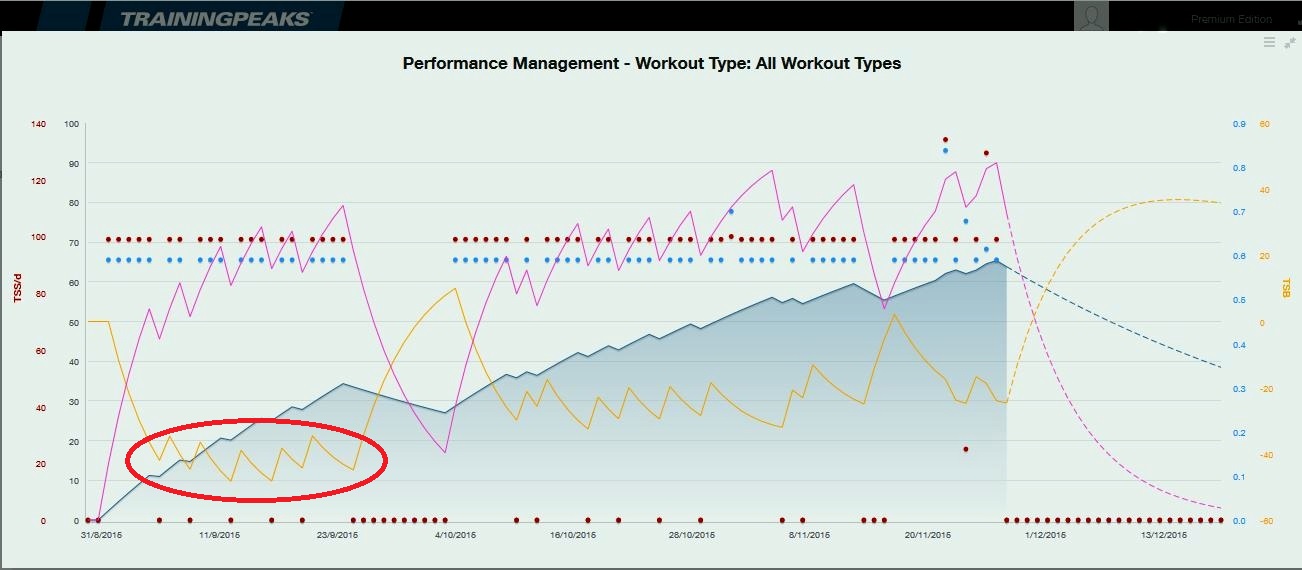
Massive overtraining (circled in red) recorded in Training Peaks... or not.
I'm giving Training Peaks a try. I'll get onto a fuller review at a later date, but here are a few snippets to start out.

1. The "app" seems to be an add-on to the online program, rather than being a stand-alone app.

2. There is a "free" version and a paid "premium" version. The "free" version is basically a training diary, plus the program calculates how "tough" the workout was (Tss - training stress score). The "premium" version (costs £75, $120, €105 per year) gives you the fancy graph you see above.

3. Training Peaks makes the usual "default" assumptions - no, my resting heart rate ISN'T 60 (!) and my "threshold" heart rate ISN'T 148 either!

4. The "default" assumptions can be changed, but only in the computer version, not the app.

5. The amount of information is almost overwhelming. Be prepared to a lot of reading up on various topics to get the best out of Training Peaks.
Or get a coach that can do it for you!

6. Training Peaks, even in the "free" version, allows some pretty fancy analysis - stuff that "free" Strava users can only dream about.
"Premium" users get to see the graph at the top of the page which allows even more analysis.
For example, do you know when you are recovered enough from a hard training session to take on an event? How long should your tapering period be? (If you don't taper, then I think "premium" Training Peaks might be a bit beyond your needs for the moment. Even I taper!)
(update: Strava has a "fitness and freshness" page in "Premium", but it was really Training Peaks that started this stuff!)

7. Training Peaks assumes you start logging you rides etc. from a low level of fitness. So you look ("premium" version only) like you are getting massively fit in the first few weeks, but are so fatigued that you should be unable to walk, let alone train. I "preloaded" about 2 months of estimated activities to "flatten out" the initial training figures. Another few months of "real" activities, and the graphs will be showing sensible numbers ... An example can be seen in the picture at the top of the post ("premium" version only), where Training Peaks has assumed my fitness level is far lower than it actually is, and the area I have marked in red would normally be showing a dangerous level of overtraining, but it just a "getting going" artifact.
See the update section further down for an example of a more sensible graph that I have preloaded with the bulk of my major activities going back about 4 months. Yes, I really do perform about 100 TSS points of activity at medium intensity on 5 days or so a week!
You can set "start fitness" numbers in Training Peaks, but without a coach, or a friend who uses Training Peaks, how would you know what numbers to start at?
8 ... Which leads to the next point. If you are going to switch to Training Peaks, then do so when doing general training in the "off-season", NOT while doing structured training in the run-up to an event. Training Peaks relies on quite a few months of data input to give realistic (and useful) graphs (I'm getting bored of writing it, but, again, premium version only).
I believed I have helped things along by loading up about 4 months of activities, including a lot of manual entries to cover the stuff that I don't bother logging on Strava - I don't wear an HRM 14 hours a day, you know!

9. For me, the best feature is the summary graph (yep, premium version only) that shows fatigue, fitness, and "balance". The object is to get fitness as high as possible, yet get "balance" positive by the time you do an event. Exercise increases fatigue and fitness, but rest causes fatigue to fall faster than fitness (this is basically why we get fitter by doing exercise!). Too much rest, and fitness falls unnecessarily - once you are decently rested, further rest won't help, yet fitness is falling all the time. Training Peaks aims to help you get that balance right. In the picture at the top of the post, the blue line (with the shading below it) is my level of fitness, the pink line is my fatigue, and the yellow line is my balance of fitness and fatigue. In the picture above, I can see that if I had an event/race/sportive coming up, I should rest up for a few days, during which time I will lose a little fitness, but recover from a LOT of fatigue. Really, I should be trying to get the fitness line (blue) as high as possible and at the same time get the balance line (yellow) back into the "positive" range before an event/race/sportive.
But don't worry too much about my graph for the moment - the system has yet to catch up with the decent level of fitness I already have :-)

10. Like I said in 8 above, start using Training Peaks BEFORE you need it because in the first few months of use, the figures for fatigue and recovery aren't going to be that accurate unless you really are as unfit as the program assumes. Get a good few months of data in there, and it should sort itself out. See the graph further down to see how loading about 4 months of "old" activities makes the numbers look more sensible. I have kind of repeated this point because it is SO important!

11. You have a LOT of flexibility in how to enter workouts. If you do a regular thing and you work out training load (expressed as tss and intensity) then you can add a manual entry WITH the full effects showing on the training graphs ( you know what I am going to say - premium version only), rather than just the Strava way of adding it to total mileage, but not much else.
I do a physical job, so I measured the outdoor part of it with my 310xt and HRM belt today. So I got an estimate of how much "training" I do as a by-product of my job. Turns out to be quite a bit. I walk about 5 miles (8km) a day, just for starters. But I don't have to measure it every day. I can just use today's figure for a manual entry for other days. Yes, every month or so, I ought to recalibrate the activity, because if I am getting fitter than I am likely to be doing the same amount of "work" at a lower heart-rate, and therefore incurring less "training". But at least I can do it like that.
I don't wear an HRM 24 hours a day, so it is good to be able to make an "educated estimate" of workload. But you have to be honest with yourself - that 30 minute gym session is unlikely to be the same as a 100km cycle session, however much you sweated!

12. No social side. You can make your training public, but if you want social, then that is what Strava is for.

13. No segments. If you want to pretend you are a top rider, then, again, that is catered for by Strava. If you want to train to be closer to actually being a top rider, then that is where programs like Training Peaks take over. Training Peaks isn't about competing with your mates, it is about competing with yourself. Segments can still be useful as training exercises, though, as part of a broader training program.

14. No little trophies and badges. Play on Strava, Train on Training Peaks.

15. Is Training Peaks better than Strava, then? Nope. It is just different, to do different things. I've met a lot of interesting folks through Strava, and picked up a lot of tips. I still use Strava. I like the badges :-) I like the social side. Indeed, my runs and rides are currently "auto-forwarding" from Garmin Connect to both Strava AND Training Peaks.
But Training Peaks has better training tools, especially in the "premium" version, as long as you are prepared to put the hours in to learn how to use those tools properly. Twelve months ago, I would have found Training Peaks rather intimidating. Since then I have read half a dozen training books, maybe 50 scientific papers on training, and a lot of general training articles and blogs. I have spoken to long term marathon runners to check that what I am reading makes sense. I did my first 200+km ride, and about 6 other "metric" centuries. I've learnt a lot, and developed a lot. I think I am ready for Training Peaks. But like I have mentioned before, it is a steep learning curve for a novice without a coach to understand all the graphs and their purpose.
There we are just a taster. I'll do a proper review in a couple of months time when I can say for certain whether the numbers have settled down after there initial rise from an assumed-low base.

Update 29th November 2015:
The first graph again, showing "start-up" artefacts even after being pre-loaded with a couple of months of (mainly) estimated data.

That;s a bit more like it. The data for the last couple of months is the same as the first chart (excepting I have added another day or two to the "current" end). But this time I have added all my big rides and every run I made that was 5km or over, stretching back to July (so about 5 months of data in total). I have similarly used estimates for the non-Garmin part of my training.Slowly rising fitness, with big improvements in "balance" when I have a few days off from work.
After all, I SHOULD have gotten fitter in November - I have run two 10Km runs, and those are the first 10Kms since late July.
So easy to come up with a basic training plan with Training Peaks.
I just entered how many hours a week I wanted as training (1 chose 10). then I enetered any big events I have, and how important they are to me.
For me the "big" event is the one in the middle of the plan (the end of June). It is the local charity "sportive" 100km ride.Then later, near the end of August, I fancy a go at beating my PR for distance in a day. I did 161km in 2014, 232km in 2015, and it would be nice to push the 300km mark in 2016.
These two events are marked with the little trophy with an "A" on it (A = the most important stuff).
I like to start the year with a January 1st ride, so I put in a 50km for that date. But if it doesn't happen, it doesn't happen. I can reschedule it for another day. So that one is just a "C" on the trophy symbol.
The plan is in grey, because it is a plan. When I actual do some of the training, the grey bars get replaced with coloured ones, so I can see what I have done, and what I still have to do.
The plan has added a "light" week on every 4th week (for recovery). Train for more than about 3 months without a "recovery week" and your chance of an injury goes up quite a bit! My busy life means I tend to get a rest week every now and then anyway!
Of course, the plan is fully customisable, so if you really know what you are doing, or you have a coach, they can fiddle with the plan to get the best from it.
But for the rest of us, a decent, sensible, "automatic" plan is a good place to start,
It even handles my "double peak" in the Summer in a sensible manner.